Money
There is very little at the bottom of the bands here
That is the policy working as designed, and it is worth knowing before you build a plan around a number.
| Per person per night | What it buys |
|---|---|
| US$800 – 1,200 | Established camps in genuinely good locations, a private vehicle throughout, light-aircraft hops between parks rather than long road transfers, and guiding that is a profession rather than a job. The entry point to a safari that does not compromise. |
| US$1,200 – 1,800 | Camps on private land, where the rules change: off-road driving to a sighting, night drives, walking with an armed guide, and a cap on how many vehicles may attend anything. Usually the point at which people stop comparing safaris on price. |
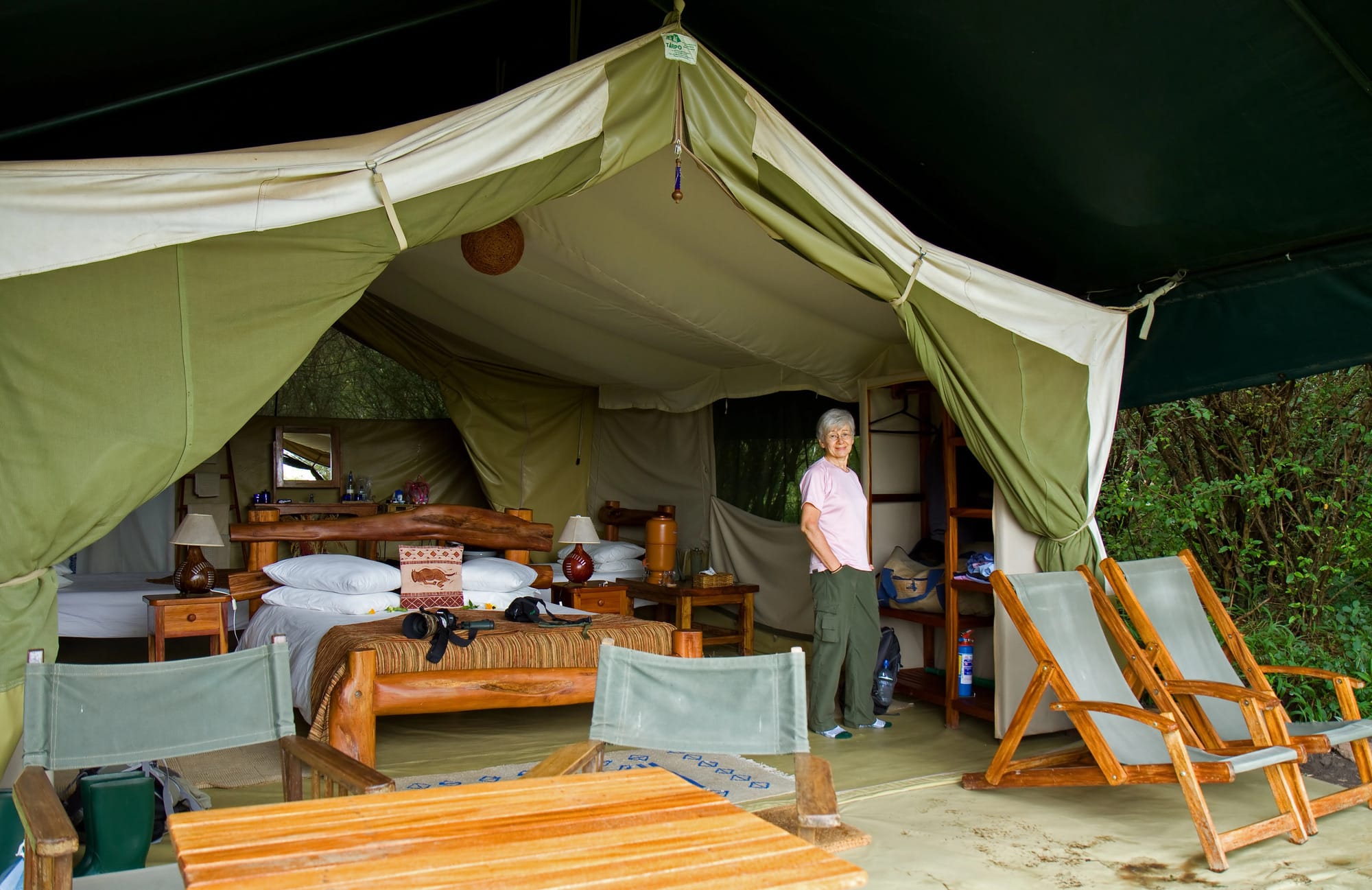
| US$1,800 – 2,500 | The camps people name when they get home. Six to ten tents, an owner or manager who is present, a guide assigned to you for the stay, and food that would hold its own in a city. |
| US$2,500 – 4,000 | A guide who travels with you from park to park rather than being handed over at each one, private charters on your own schedule, and small camps taken whole for your party. |
| US$4,000 and up | Exclusive-use houses and villas with their own staff, mobile expedition camps built for your route, and private aircraft between countries. Bought for privacy and control rather than for thread count. |
Indicative planning ranges only, per person per night sharing, for a fully inclusive safari — accommodation, meals, park and conservancy fees, guiding, and transport between parks. They are what we see in the market, not a quote and not an official tariff. Your quote will be exact and itemised. International flights are not included.
What sits on top
- Light aircraft legs, per person per move — and almost every move here is one. This is a larger share of a Botswana total than of anywhere else we plan.
- Park and concession fees, per person per day, sometimes inside a camp rate and sometimes not.
- Premium drinks and certain activities, which vary by camp more than people expect.
- A first or last night near an airport where the schedules do not line up.
The three changes that work
Move the dates into a shoulder month. The largest lever available, and it does not touch the quality of the trip — decent water, concentrating game, thinner vehicle numbers, meaningfully lower rates.
Reduce to two regions. Every move is a flight, two transfers and a half-eaten day. Two regions properly beats three in a hurry, and it is cheaper.
Look at the green season seriously, particularly for the Kalahari and the pans, which are at their best when the rest of the country is quiet and cheap.
Where not to economise
On nights per camp. Two-night stays waste the flight that got you there and turn an expensive trip into a series of arrivals.
On the land. A cheaper camp on public park land under statutory rules is a different product, not a discounted version of a concession camp.
For parties of eight or more
Ask about taking a whole camp. Small camps price as units more readily here than almost anywhere, because nine tents is a reachable number, and the per-head result is frequently better than the same party booked as individual tents.
What we itemise
Beds, park and concession fees, levies, every flight leg, transfers and any charter, shown separately. Botswana totals are dominated by the flying, which is exactly why it must not be folded into a per-night figure.
Ready to turn this into a real itinerary?
Send us your dates, who is travelling and roughly what you want to spend per person per night. Our Botswana specialist comes back within 24 hours with a plan built around them and a costed quote.